


Choosing a broker feels overwhelming when you're staring at 100+ options, each claiming to be the best.

Daniel Harrington
Senior Trading Analyst · MT5 specialist
☕ 5 min read
What you'll learn:
Choosing a broker feels overwhelming when you're staring at 100+ options, each claiming to be the best. The truth is, there's no single "best broker" — only the best broker for your specific trading style, budget, and goals. A scalper needs ultra-tight spreads and fast execution. A swing trader prioritizes regulation and instrument range. A prop firm trader needs specific leverage settings. This guide helps you match your profile to the right broker.
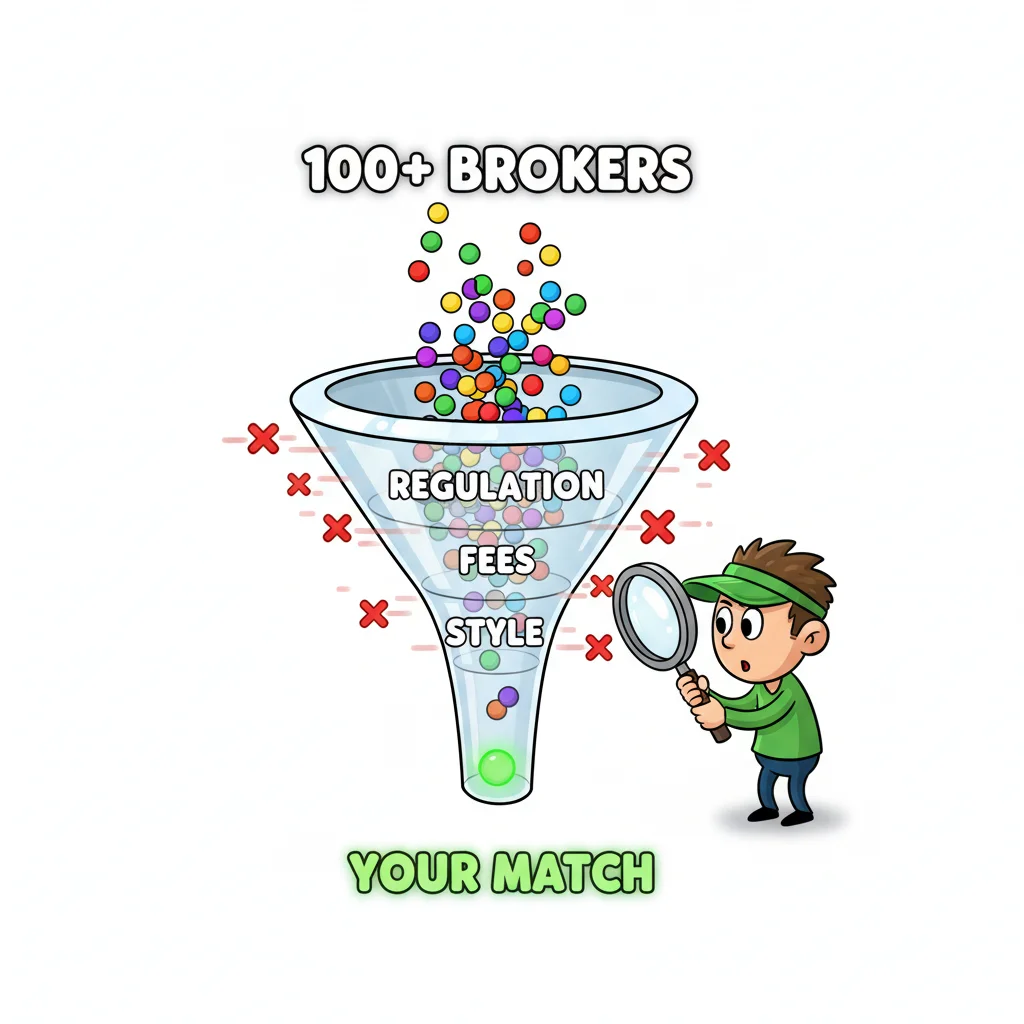
There is no single best broker — only the best broker for your trading style, budget, and goals. This filter narrows 100+ options to the one that fits.
Why Your Broker Choice Matters More Than Your Strategy
Most beginners spend weeks choosing a strategy but minutes choosing a broker. That's backwards. Here's why:
Spread costs compound — If you trade 5 lots/day on EUR/USD, the difference between a 0.6 pip spread and a 1.6 pip spread is $50/day, or $13,200/year. That's often the difference between profitability and loss.
Execution quality affects entries — A 200ms delay on a breakout trade can mean entering 5-10 pips worse than planned. Over 200 trades, that's 1,000-2,000 pips of slippage.
Regulation protects your capital — Unregulated brokers can freeze withdrawals, manipulate prices, or simply disappear. Over $2 billion has been lost to broker fraud in the last decade.
Platform stability — If your broker's servers crash during NFP, your stop loss won't execute. Uptime of 99.9%+ is non-negotiable.
Use our spread cost calculator to see exactly how much your broker choice costs you over time.
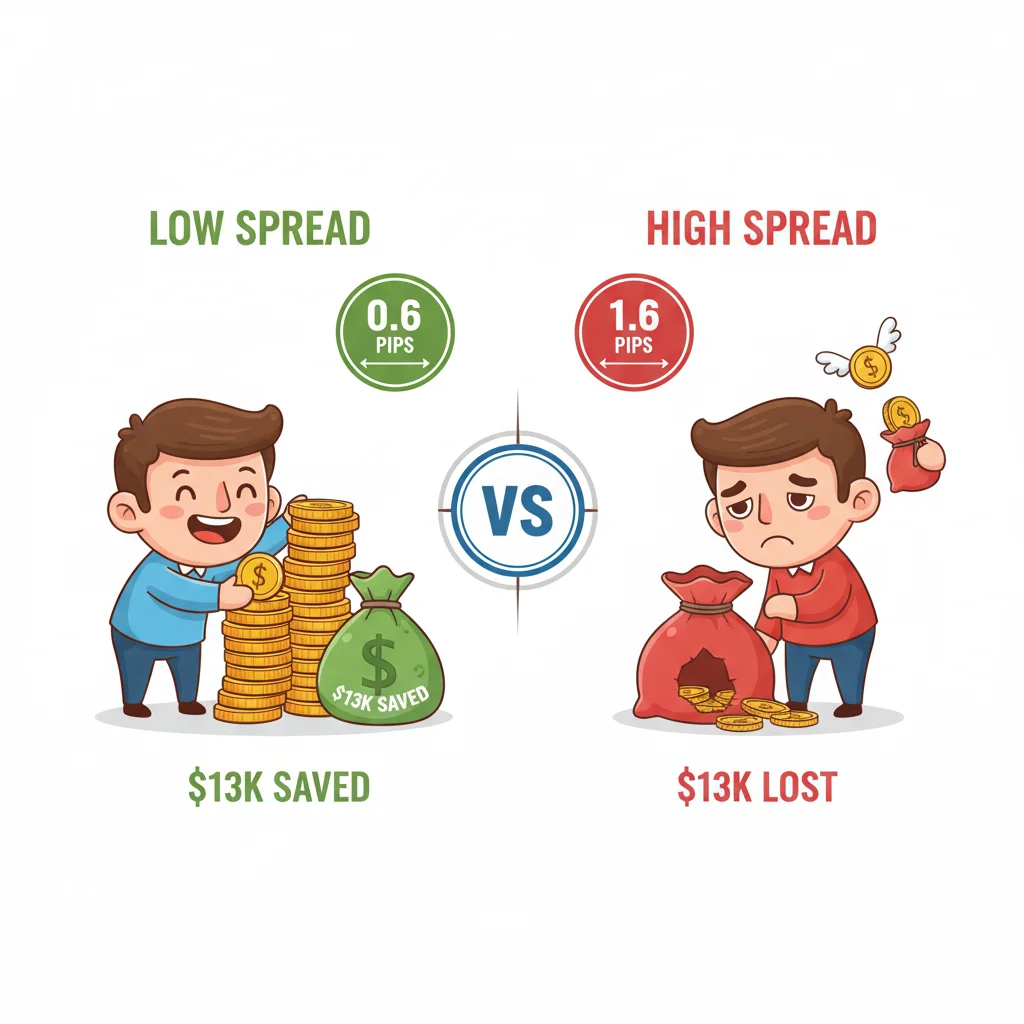
The difference between a 0.6 and 1.6 pip spread on EUR/USD is $50 per day if you trade 5 lots. That is $13,000 per year — often the difference between profit and loss.
The 5 Broker Categories: Which One Fits You?
Brokers fall into distinct categories, each suited to different trader profiles:
1. ECN/Raw Spread Brokers — IC Markets, Pepperstone
- Spreads from 0.0 pips + commission ($3-7/lot)
- Best for: Scalpers, algorithmic traders, high-volume traders
- You pay less in total costs despite the commission
2. Standard Spread Brokers — XM, OANDA
- Spreads from 1.0-1.6 pips, no commission
- Best for: Beginners, swing traders, low-frequency traders
- Simpler cost structure, easier to calculate risk
3. Social/Copy Trading Brokers — eToro
- Higher spreads (1.0-3.0 pips) but copy trading features
- Best for: Beginners who want to learn by following experienced traders
4. Multi-Asset Brokers — Interactive Brokers
- Access to stocks, options, futures, bonds + forex
- Best for: Portfolio traders who want everything in one account
5. High-Leverage Offshore Brokers — Exness
- Leverage up to 1:2000, minimal regulation
- Best for: Experienced traders who understand the risks
- Warning: No regulatory protection if the broker fails

💡 Winston's Tip
Regulation is the single most important factor.
Regulation: The Non-Negotiable Criterion
Regulation is the single most important factor. Here's the tier system:
Tier 1 (Strongest) — FCA (UK), ASIC (Australia), FINMA (Switzerland), CFTC/NFA (US), MAS (Singapore)
- Segregated client funds
- Compensation schemes (up to £85,000 with FCA)
- Regular audits and capital requirements
Tier 2 (Good) — CySEC (Cyprus/EU), BaFin (Germany), DFSA (Dubai)
- EU investor protection up to €20,000
- Passporting across all EU countries
Tier 3 (Minimal) — FSA (Seychelles), FSC (Mauritius), SVG, BVI
- Very light oversight
- No compensation schemes
- Higher leverage allowed but higher risk
Our recommendation: Always choose a Tier 1 or Tier 2 regulated broker for your main trading account. If you want higher leverage, use a Tier 3 broker only with money you can afford to lose.
Check our country-specific guides to see which regulators operate in your jurisdiction.

A broker can hold 5 licenses but register your account under the offshore one. Always verify which entity YOU trade with — not which ones they advertise.
Spreads and Commissions: How to Compare Fairly
Brokers advertise "spreads from 0.0 pips" but the reality is more nuanced:
Typical spread vs. minimum spread — A broker's minimum spread might be 0.0 pips during London session on EUR/USD, but the average is 0.6 pips. Always look at typical/average spreads.
Commission-inclusive costs — An ECN broker with 0.2 pip spread + $7/lot commission costs 0.9 pips total. A standard broker with 1.2 pip spread and no commission costs 1.2 pips total. The ECN broker is cheaper.
Swap rates — If you hold positions overnight, you pay or receive swap (interest). This varies enormously between brokers and can add up on swing trades.
Deposit/withdrawal fees — Some brokers charge $25+ for wire transfers or have minimum withdrawal amounts. Check before you deposit.
Inactivity fees — Some brokers charge $10-50/month after 3-12 months of inactivity. Close your account if you stop trading.
Compare broker costs side-by-side using our broker comparison pages.
💡 Winston's Tip
If you're a Scalper (holding minutes): - Priority: Lowest possible spread + fast execution - Need: ECN/raw spread accoun...
Matching Your Trading Style to a Broker
If you're a Scalper (holding minutes):
- Priority: Lowest possible spread + fast execution
- Need: ECN/raw spread account, VPS hosting
- Look for: Sub-50ms execution, no dealing desk
- Best options: IC Markets, Pepperstone, Tickmill
If you're a Day Trader (holding hours):
- Priority: Reasonable spreads + good charting tools
- Need: Reliable platform, economic calendar
- Look for: Spreads under 1.0 pip on majors
- Best options: OANDA, Forex.com
If you're a Swing Trader (holding days/weeks):
- Priority: Low swap rates + strong regulation
- Need: Swap-free option if holding long term
- Look for: Positive swap on your preferred pairs
- Best options: Saxo Bank, IG
If you're a Prop Firm Trader:
- Priority: Specific leverage, rule-compliant execution
- Need: Tools to monitor daily drawdown
- Look for: Prop firm compatibility, risk management tools
- Pulsar Terminal's built-in prop firm protection automatically prevents rule violations
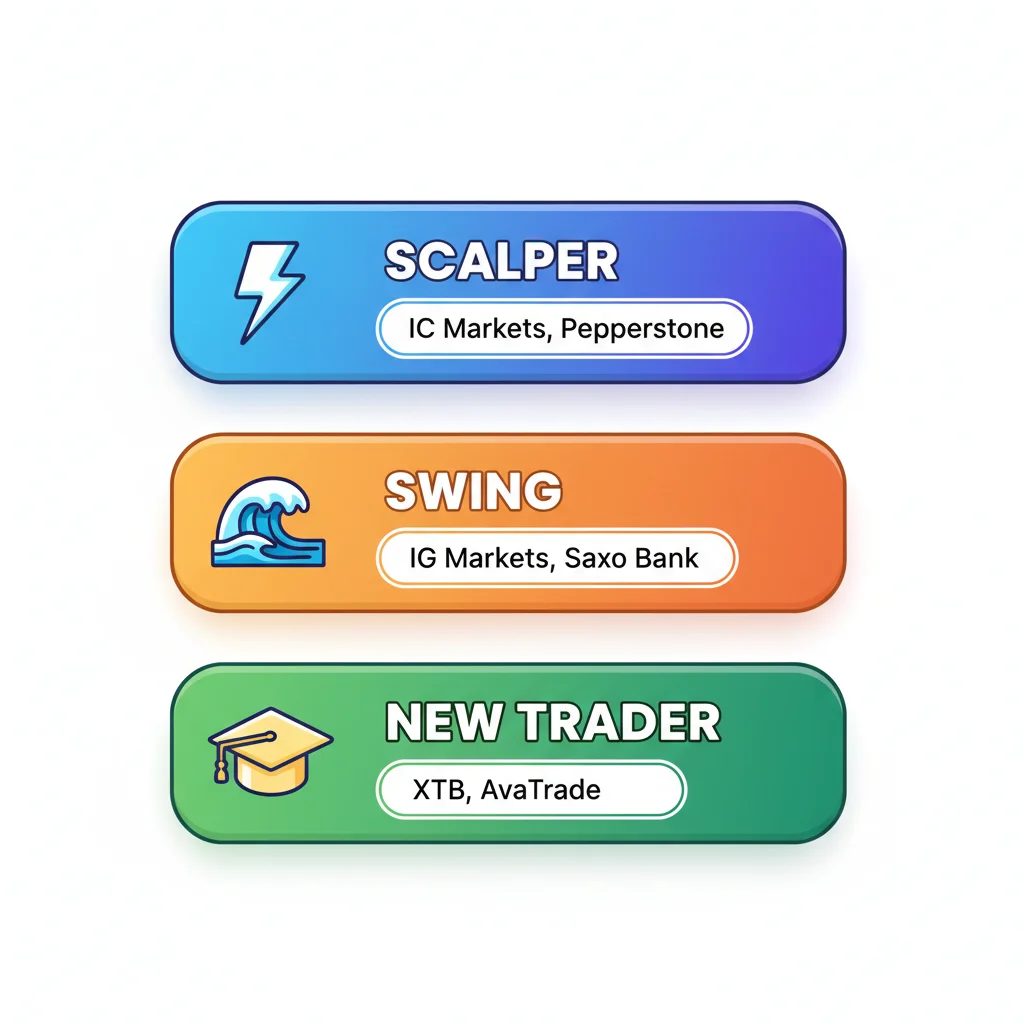
A scalper at Saxo Bank or a swing trader at a raw-spread-only broker is a mismatch. Your trading style determines which features actually matter.
Red Flags: When to Avoid a Broker
Walk away if you see any of these warning signs:
No clear regulation — If the broker can't tell you exactly which regulator oversees them and their license number, don't deposit.
Guaranteed profits — No legitimate broker promises returns. Trading involves risk, period.
Bonus offers with conditions — "100% deposit bonus" usually means you can't withdraw until you trade 30x the bonus amount. The math rarely works in your favor.
Withdrawal complaints — Check Trustpilot, ForexPeaceArmy, and Reddit for patterns of withdrawal delays or denials.
Requotes on every trade — Occasional requotes are normal during high volatility. Constant requotes suggest the broker is trading against you.
Pressure to deposit more — If your "account manager" keeps calling to encourage larger deposits, that's a sales operation, not a brokerage.
Too-good-to-be-true spreads — If a broker offers 0.0 spreads with no commission, they're making money some other way (widening during volatility, stop hunting, or they're simply undercapitalized).

Guaranteed returns, no regulation, pressure to deposit more — if it sounds too good to be true, it always is.
Prof. Winston's Lesson
Key Takeaways:
- ✓There is no single best broker — only the best broker for your specific trading style
- ✓Regulation is non-negotiable: FCA, ASIC, CySEC, or equivalent Tier-1 license required
- ✓Compare spreads on YOUR instruments during YOUR trading hours, not just advertised minimums
- ✓Red flags to avoid: no regulation, guaranteed profits, withdrawal complaints, and pressure tactics

❓ Frequently Asked Questions
Q1Can I have accounts with multiple brokers?
Absolutely. Many experienced traders use 2-3 brokers: one for day trading (low spreads), one for swing trading (good swaps), and one for long-term investing (multi-asset). There's no rule against it.
Q2Should I start with a demo or live account?
Always start with demo. Practice for at least 2-3 months until you're comfortable with the platform, your strategy, and order execution. Then switch to live with a small amount you can afford to lose.
Q3Is my money safe with a regulated broker?
Regulated brokers must keep client funds in segregated accounts separate from company funds. If the broker goes bankrupt, your money is protected. FCA-regulated brokers offer additional protection up to £85,000 through the FSCS.
Q4Do all brokers offer MT5?
Most major brokers now offer MT5 alongside or instead of MT4. Some brokers like eToro use proprietary platforms. If MT5 is important to you (and it should be for serious trading), verify MT5 availability before opening an account.
How useful was this article?
Click a star to rate
Comments
Stay ahead of the markets
Get weekly market analysis, trading strategies, and MT5 tips delivered to your inbox. No spam, unsubscribe anytime.
About the Author
Daniel Harrington
Senior Trading Analyst
Daniel Harrington is a Senior Trading Analyst with a MScF (Master of Science in Finance) specializing in quantitative asset and risk management. With over 12 years of experience in forex and derivatives markets, he covers MT5 platform optimization, algorithmic trading strategies, and practical insights for retail traders.
Get Pulsar Terminal
All these calculators are built into Pulsar Terminal with real-time data from your MT5 account. One-click position sizing, automatic risk management, and instant calculations.
Get Pulsar TerminalYou Might Also Like

Risk Disclaimer
Trading financial instruments carries significant risk and may not be suitable for all investors. Past performance does not guarantee future results. This content is for educational purposes only and should not be considered investment advice. Always conduct your own research before trading.